In this article, you’ll discover: Introduction “But aren’t timber windows easier to break into?” It’s a question rooted in outdated assumptions. People picture Victorian sash windows with single latches, easily forced with a screwdriver. Modern timber windows bear no resemblance to that image. Today’s timber windows incorporate the same advanced locking systems as any material […]
https://timberwindows-direct.co.uk/wp-content/uploads/2026/05/cacb575c-3d74-40fd-8249-dad62e072170.png10241536Michal Plonskihttps://timberwindows-direct.co.uk/wp-content/uploads/2017/06/TWD-logo-small.pngMichal Plonski2026-04-21 08:58:322026-05-02 09:01:37How Secure Are Timber Windows? A Modern Security Guide
In this article, you’ll discover: Introduction The frame is where window quality lives or dies. Two windows can use identical glass, identical hardware, and look similar from across the room — yet perform completely differently because of frame construction and materials. Most homeowners focus on glazing specifications and opening styles. Those matter. But the frame […]
In this article, you’ll discover: Introduction “But aren’t timber windows easier to break into?” It’s a question rooted in outdated assumptions. People picture Victorian sash windows with single latches, easily forced with a screwdriver. Modern timber windows bear no resemblance to that image. Today’s timber windows incorporate the same advanced locking systems as any material […]
https://timberwindows-direct.co.uk/wp-content/uploads/2026/05/cacb575c-3d74-40fd-8249-dad62e072170.png10241536Michal Plonskihttps://timberwindows-direct.co.uk/wp-content/uploads/2017/06/TWD-logo-small.pngMichal Plonski2026-04-21 08:58:322026-05-02 09:01:37How Secure Are Timber Windows? A Modern Security Guide
In this article, you’ll discover: Introduction The frame is where window quality lives or dies. Two windows can use identical glass, identical hardware, and look similar from across the room — yet perform completely differently because of frame construction and materials. Most homeowners focus on glazing specifications and opening styles. Those matter. But the frame […]
Why modern timber windows can be more secure than uPVC
Multi-point locking systems and how they work
PAS 24 security standards and what they mean
Insurance requirements for window security
The hardware that makes timber windows genuinely secure
Introduction
“But aren’t timber windows easier to break into?” It’s a question rooted in outdated assumptions. People picture Victorian sash windows with single latches, easily forced with a screwdriver. Modern timber windows bear no resemblance to that image.
Today’s timber windows incorporate the same advanced locking systems as any material — multi-point locks, shootbolts, laminated glass, key-locking handles. The timber frame itself is arguably harder to compromise than uPVC, which can flex and distort under pressure.
We manufacture timber windows to the highest security specifications, including PAS 24 certification where required. This guide explains what modern timber window security actually involves and how to ensure your windows meet both practical security needs and insurance requirements.
Multi-Point Locking Systems
The days of single-point locks are long gone. Modern timber windows use sophisticated multi-point systems.
How Multi-Point Locks Work
When you turn the handle, multiple locking points engage simultaneously around the frame perimeter. A typical system includes:
Hooks or bolts at multiple positions (typically 3-7 points)
Shootbolts extending into the frame head and sill
Central latch engaging the keep in the frame
Compression seals pulled tight by the locking action
The result: force applied at any single point must overcome resistance distributed across the entire frame. Breaking in means defeating multiple locks simultaneously — dramatically harder than forcing one.
Lock Point Configurations
Configuration
Security Level
Typical Application
3-point
Good
Upper floor windows, low-risk areas
5-point
Very good
Ground floor, standard residential
7-point
Excellent
High-risk locations, enhanced security
For most ground floor applications, 5-point locking provides excellent security. 7-point systems suit properties in higher-risk areas or where maximum security is required.
PAS 24: The Security Standard Explained
PAS 24 is the British security standard for windows and doors. Understanding it helps you specify appropriately.
What PAS 24 Means
PAS 24 (now formally BS EN PAS 24) is a publicly available specification for enhanced security performance. Windows certified to PAS 24 have passed rigorous testing including:
Manual attack tests — attempts to force entry using common burglary tools
Cylinder security tests — resistance to lock snapping, picking, drilling
Hardware durability tests — locking mechanisms tested for reliability
A PAS 24 certified window isn’t just fitted with good locks — the entire window (frame, glazing, hardware) has been tested as a complete system.
When PAS 24 Is Required
Building Regulations Approved Document Q requires “secure windows” for new builds and certain conversions. PAS 24 certification is the simplest way to demonstrate compliance.
For replacement windows in existing homes, PAS 24 isn’t legally required — but insurers increasingly expect it for ground floor and accessible windows.
PAS 24 and Timber Windows
Timber windows achieve PAS 24 certification readily. The inherent strength of timber frames — particularly hardwood — provides excellent resistance to forced entry. Combined with appropriate hardware, timber meets and exceeds the standard.
Glazing Security Options
The glass matters as much as the locks.
Laminated Glass
Laminated glass consists of two or more glass panes bonded with a plastic interlayer (typically PVB). When broken, fragments adhere to the interlayer rather than shattering.
Security benefits:
Penetration resistance — breaking through requires sustained effort
Fragment retention — no clean entry through broken glass
For ground floor windows, laminated glass significantly improves security. It’s also required for PAS 24 certification in most configurations.
Toughened vs Laminated
Toughened glass is stronger than standard glass but shatters completely when broken — creating easy access once compromised. For security, laminated outperforms toughened. For safety (preventing injury from broken glass), both work.
The ideal security specification: laminated glass on the outer pane, toughened on the inner.
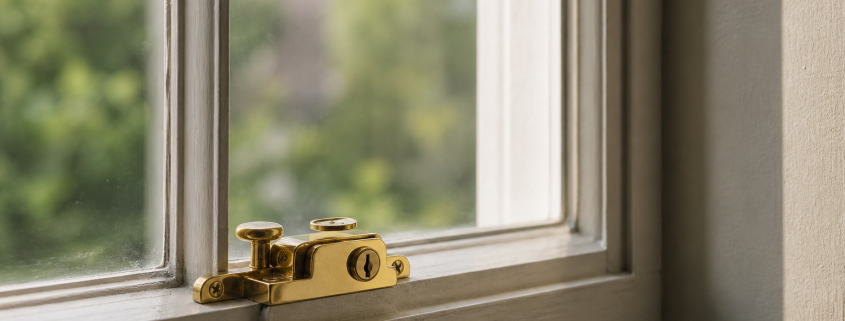
Handles that lock with a removable key prevent operation even if an intruder breaks glass and reaches inside. Essential for:
Ground floor windows
Windows accessible from flat roofs or balconies
Any window within reach of a door or other opening
Key-locking handles are standard on most modern timber windows. Ensure keys are removed when the property is unoccupied.
Shootbolts
Shootbolts extend from the opening sash into the frame head and sill, providing locking points where multi-point systems don’t reach. They’re particularly valuable on:
Large windows — additional security for wider spans
Hinge Security
Modern friction stays and hinges include security features:
Restricted opening — prevents removal when window is ajar
Anti-lift devices — stops sash being lifted from hinges
Concealed fixings — no external access to hinge screws
Timber vs uPVC Security
How does timber actually compare?
Frame Strength
Timber frames are inherently rigid. uPVC frames can flex under sustained pressure, potentially allowing enough distortion to disengage locks. This isn’t theoretical — police reports note uPVC frame manipulation as a known entry method.
Hardwood timber frames — particularly oak and accoya — offer superior rigidity. Even engineered softwood outperforms uPVC for resistance to distortion.
Hardware Compatibility
Timber accepts all hardware types securely. Screws bite firmly into solid timber; fixings hold under stress. uPVC requires steel reinforcement for secure hardware mounting — when that reinforcement is inadequate or absent, locks can pull away under force.
The Verdict
With equivalent hardware, timber windows are at least as secure as uPVC — and arguably more so due to superior frame rigidity and hardware retention. The “timber is less secure” perception reflects historic windows, not modern manufacturing.
Insurance Requirements
Your insurer may specify minimum security standards.
Typical Requirements
Most household insurers require:
BS 7950 (or equivalent) locks — most multi-point systems qualify
Key-operated locks on accessible windows — ground floor, near flat roofs
Locks engaged when property unoccupied — obvious but often specified
Some insurers now require or incentivise PAS 24 windows for new installations or claims following break-ins.
Checking Your Policy
Before specifying windows, check your insurance policy’s security requirements. Look for:
Named standards (BS 7950, PAS 24)
Specific hardware requirements
Accessible window definitions
Any new-for-old replacement conditions
We can advise on hardware specifications to meet common insurance requirements.
Frequently Asked Questions
Are timber windows secure enough for ground floor use?
Absolutely. Modern timber windows with multi-point locking, key-operated handles, and laminated glass meet or exceed security standards for ground floor installation. PAS 24 certified timber windows pass the same rigorous testing as any material. The timber frame’s rigidity actually provides advantages over uPVC in resisting forced entry.
What is PAS 24 certification?
PAS 24 is the British standard for enhanced security windows and doors. Certified products have passed manual attack testing, lock manipulation tests, and durability assessments. It’s required for new builds under Building Regulations Approved Document Q and increasingly expected by insurers. Timber windows achieve PAS 24 certification readily.
Do I need laminated glass for security?
For ground floor and accessible windows, laminated glass significantly improves security by resisting penetration even when cracked. It’s required for PAS 24 certification in most configurations. Upper floor windows can use standard double glazing unless specific security concerns exist.
Will my insurance cover timber windows?
Yes — insurers don’t discriminate by frame material. They care about locking systems and glazing specifications. Ensure your timber windows meet any security standards specified in your policy (typically BS 7950 locks minimum). PAS 24 certification satisfies most insurance requirements automatically.
How do timber window locks compare to uPVC?
Modern timber and uPVC windows use identical locking mechanisms — the same multi-point systems, shootbolts, and handles. The difference is how securely the frame holds that hardware. Timber’s rigidity and screw-holding capacity often exceeds uPVC, particularly with hardwood frames.
Conclusion
Modern timber windows are highly secure — matching or exceeding uPVC and aluminium alternatives. Multi-point locking systems, laminated glass, key-operated handles, and PAS 24 certification provide comprehensive protection against forced entry.
The timber frame itself contributes to security: its rigidity resists distortion, and solid wood holds hardware fixings firmly under stress. The outdated perception of vulnerable timber windows reflects historic designs, not contemporary manufacturing.
At Timber Windows Direct, we manufacture timber windows with security hardware to your specification — from standard 5-point locking to full PAS 24 certification. Request your free quote and let’s discuss the security specification that suits your property.
https://timberwindows-direct.co.uk/wp-content/uploads/2026/05/cacb575c-3d74-40fd-8249-dad62e072170.png10241536Michal Plonskihttps://timberwindows-direct.co.uk/wp-content/uploads/2017/06/TWD-logo-small.pngMichal Plonski2026-04-21 08:58:322026-05-02 09:01:37How Secure Are Timber Windows? A Modern Security Guide
How timber window frames are constructed — the joinery that matters
Which timber species work best for window frames
Why frame depth affects thermal performance
How to match frame specification to your property’s needs
Maintenance requirements by frame type
What separates quality frames from budget alternatives
Introduction
The frame is where window quality lives or dies. Two windows can use identical glass, identical hardware, and look similar from across the room — yet perform completely differently because of frame construction and materials.
Most homeowners focus on glazing specifications and opening styles. Those matter. But the frame determines how long your windows last, how well they insulate, how smoothly they operate, and whether they’ll still work properly in twenty years.
We’ve manufactured timber windows for over a decade, and frame quality is where we see the biggest variation between suppliers. This guide explains what actually matters in timber frame construction — the decisions that affect performance, longevity, and value.
Frame Construction Methods
How timber frames are joined determines their strength and longevity.
Mortise and Tenon Joinery
The gold standard for timber window frames. A mortise (rectangular hole) is cut into one piece; a tenon (shaped projection) on another piece fits precisely into it. The joint is glued and often pinned.
Why it matters:
Mechanical strength — the joint resists stress in multiple directions
Large glue surface — maximises adhesive bond
Historic precedent — proven over centuries of use
Repairability — joints can be disassembled for restoration
Mortise and tenon joints require skill and precision. They’re slower to produce than simpler alternatives, which is why budget manufacturers avoid them.
Combed or Finger Joints
Interlocking “fingers” cut into both pieces create a strong glued joint. Commonly used for:
Joining shorter timber pieces into longer lengths
Frame corner construction in some systems
Engineered timber production
Combed joints are strong in tension but less robust than mortise and tenon under racking (twisting) stress. They’re acceptable for engineered timber sections but shouldn’t replace mortise and tenon at critical frame corners.
Dowel Joints
Cylindrical dowels align and reinforce glued butt joints. Faster to produce than mortise and tenon, with reasonable strength.
Dowel joints work adequately but lack the mechanical robustness of traditional joinery. They’re common in budget timber windows and standard in uPVC (where internal reinforcement compensates).
What to Specify
For premium timber windows, insist on mortise and tenon joinery at frame corners and where sashes meet frames. Combed joints are acceptable within engineered timber sections. Avoid dowel-only construction for external joinery.
Timber Species for Frames
Frame timber affects durability, appearance, maintenance requirements, and cost.
Engineered Softwood
Engineered softwood — typically Scots pine or redwood — laminated from multiple layers with alternating grain direction. This is the modern industry standard for good reason.
Frame depth directly affects what glazing you can fit — and therefore thermal performance.
Why Depth Matters
Glazing units have specific thickness requirements:
Double glazing: 24-28mm typical
Triple glazing: 36-44mm typical
The frame must accommodate the glazing unit plus adequate rebate depth for seals and beading. Insufficient frame depth means:
Limited glazing options
Potential seal compression issues
Reduced weatherproofing margins
Standard Frame Depths
Frame Depth
Glazing Capacity
Typical Application
56-58mm
Double only
Budget windows, slim profiles
68mm
Double comfortably, triple possible
Standard quality timber
78-90mm
Triple comfortable, maximum insulation
Premium, Passivhaus
For most applications, 68mm frames offer the best balance — accommodating high-performance double glazing easily and triple glazing where required.
Thermal Performance by Frame
The frame itself contributes to overall window U-value. Timber is a natural insulator with inherently low thermal conductivity (~0.13 W/mK) compared to:
uPVC: ~0.17 W/mK
Aluminium: ~160 W/mK (requires thermal breaks)
Deeper timber frames provide more insulation material between inside and outside. Combined with appropriate glazing, this achieves excellent whole-window U-values:
It depends on your priorities. For maximum longevity and heritage properties, oak is the benchmark (60-100 year lifespan). For conservation areas with realistic budgets, meranti offers excellent hardwood performance. For most modern homes prioritising value, engineered softwood delivers 30-40 years at accessible cost. Accoya suits exposed locations and sustainability-focused projects.
How does frame depth affect window performance?
Deeper frames accommodate thicker glazing units and provide more insulation material. 68mm frames handle quality double glazing and can accept triple glazing. For maximum thermal performance (Passivhaus level), 78-90mm frames are optimal. Frame depth also affects visual proportions — deeper frames suit some architectural styles better than others.
Do timber frames require more maintenance than uPVC?
Timber frames require periodic repainting (every 8-15 years depending on species and exposure). uPVC requires less routine maintenance but cannot be repaired when it fails — replacement is the only option. Over a 50-year period, properly maintained timber often proves more economical than replacing uPVC windows twice.
What joinery should I specify for timber window frames?
For quality timber windows, specify mortise and tenon joints at frame corners and critical junctions. This traditional joinery provides superior strength and longevity. Combed (finger) joints are acceptable within engineered timber sections. Avoid dowel-only construction for external joinery.
How long do timber window frames last?
Lifespan varies by species and maintenance. Engineered softwood frames typically last 30-40 years; meranti 40-50 years; oak 60-100 years; accoya 50+ years. These figures assume proper maintenance — neglected timber fails faster regardless of species. Well-maintained Victorian timber frames routinely exceed 120 years.
Are timber frames better insulators than uPVC?
Yes. Timber has lower thermal conductivity than uPVC (0.13 vs 0.17 W/mK). The difference is modest but real. Combined with equivalent glazing, timber-framed windows typically achieve slightly better U-values than uPVC equivalents. Aluminium conducts heat readily and requires thermal breaks to achieve comparable performance.
What warranty should I expect on timber window frames?
Quality manufacturers offer 10-30 year frame warranties depending on timber species and specification. Engineered softwood typically carries 10-15 years; hardwood 20-30 years; accoya often 50 years. Warranty terms matter as much as length — check conditions for maintenance requirements and exclusions.
Conclusion
The frame is the foundation of window performance. Quality timber frames — properly constructed from appropriate species — deliver decades of reliable service, excellent thermal performance, and smooth operation.
The choices matter: mortise and tenon joinery outlasts simpler alternatives; engineered softwood offers stability at accessible cost; hardwoods provide maximum longevity for heritage applications; frame depth determines glazing options and thermal performance.
Don’t accept vague specifications. Ask suppliers about joinery methods, timber grades, frame depths, and warranty terms. The answers reveal manufacturing quality more reliably than price alone.
At Timber Windows Direct, we manufacture timber window frames in engineered softwood, meranti, and oak — with mortise and tenon joinery as standard and frame depths to suit your glazing requirements. Request your free quote and let’s discuss the frame specification that suits your project.