
Timber Window Hardware: The Complete UK Guide

In this article, you’ll discover:

  • Handle types for timber windows and when to use each
  • Casement stays vs friction hinges
  • Security locks and PAS 24 explained
  • Finish options for different property styles

Window hardware might seem like a small detail. But get it wrong and you’ll be reminded every time you open a window. Handles that don’t suit the style. Stays that won’t hold. Locks that look like they belong on a garden shed.

We’ve fitted thousands of timber windows, and the hardware choices matter more than people realise. The right ironmongery enhances both look and functionality. The wrong choice? It’s like putting plastic handles on an oak front door.

Window Handles: Types and Applications

Espagnolette (Espag) Handles

The modern standard for flush casement windows. Espag handles operate a multi-point locking mechanism — when turned, locking points engage at multiple positions around the frame. Most include a key-locking position for additional security. Available in all standard finishes.

Monkey Tail and Peardrop Handles

Traditional designs with curved or rounded profiles — the go-to choice for period properties. Originated in the Georgian era and remained popular through Victorian and Edwardian times. Modern versions often incorporate espagnolette mechanisms, giving you traditional aesthetics with contemporary security.

Sash Window Hardware

For sash windows, the fitch fastener locks the two sashes together. Modern versions add key-locking for security. Sash lifts range from simple hook lifts (Georgian) to more ornate patterns (Victorian).

Casement Stays and Restrictors

Traditional Casement Stays

A flat metal bar with holes that hooks onto pins on the window sill. Simple, reliable, unchanged for over a century. Lengths vary (200mm, 250mm, 300mm) — choose based on window size. For period properties, matching finish (black antique, brass, bronze) is part of the authentic look.

Friction Hinges

The modern alternative — combines hinge and stay functions. The friction mechanism holds the window at any angle without pins or hooks. Cleaner aesthetics, easier operation, ability to reverse sash for cleaning. The trade-off is a contemporary appearance that may not suit traditional properties.

Child Safety Restrictors

Building Regulations require windows above certain heights to limit opening to 100mm unless deliberately overridden. Most friction hinges include built-in restrictors. Not optional for upper-floor windows where children might be present.

Security: Locks and Standards

Around 30% of burglaries involve window entry. Good locks make a genuine difference.

Multi-point locking: Modern espag systems engage at least three locking points simultaneously, distributing force across multiple positions rather than one latch. Higher-security windows add shootbolts extending into the frame at top and bottom.

PAS 24: The British security standard for doors and windows. Products are physically tested against defined attack sequences. Building Regulations (Part Q) require ground floor and easily accessible windows to meet PAS 24. Certification covers the complete window system — frame, glazing, and hardware together.

Key-locking considerations: Key-locked handles prevent opening even if glass is broken — but can be a fire escape hazard. Use key-locking on ground floor; non-locking on bedrooms where escape routes matter more.

Hardware Finishes

FinishBest Suited ToConsiderations
Polished ChromeModern, contemporaryShows fingerprints
Satin ChromeModern, versatileMore forgiving
Polished BrassVictorian, EdwardianRequires polishing
Antique BrassPeriod, heritageLow maintenance
Black AntiqueCottages, farmhousesVery low maintenance
BronzeArts & Crafts, high-endPremium option

General rule: match window hardware to door furniture for consistency.

Period-Appropriate Hardware

Georgian (1714-1830): Simple, elegant hardware. Fitch fasteners in brass or black, simple ring pulls or hook lifts. Understated function over ornament.

Victorian (1837-1901): More ornate patterns. Monkey tail handles with elaborate detailing, decorative stays. Polished brass or black antique ironwork.

Edwardian (1901-1910): Simpler than Victorian but still quality. Satin brass and early chrome finishes. Casement windows became more common.

For listed buildings, Historic England guidelines may restrict choices — check with your local conservation officer.

Frequently Asked Questions

Can I replace hardware without changing the window?

Often yes. Handles, stays, and fasteners can usually be upgraded. However, changing to a different locking system (e.g., adding multi-point locking) typically requires the window to be designed for it.

What finish is most durable?

PVD (Physical Vapour Deposition) finishes are most durable, followed by powder-coated. Polished brass requires regular maintenance. Black antique and bronze age gracefully.

Do I need PAS 24 rated hardware?

For new builds, Building Regulations require ground floor and easily accessible windows to meet PAS 24. For existing homes, it’s recommended but not mandatory.

Casement stays vs friction hinges?

Casement stays hold windows at fixed positions with visible fittings. Friction hinges hold at any angle without additional hardware. Stays suit period properties; friction hinges suit modern aesthetics.

Getting the Hardware Right

Think about style (what suits your property), function (security, child safety), and finish (matching other hardware). Get those three right and you won’t go wrong.

At Timber Windows Direct, we offer a full range of hardware options. Get in touch to discuss what would work best for your project.

How to Stop Condensation on Timber Windows

In this article, you’ll discover:

  • Why condensation forms on windows (and why it’s not a fault)
  • The difference between interior, exterior, and between-pane condensation
  • Four practical solutions ranked by cost and effectiveness
  • When upgrading your glazing actually makes sense

Waking up to windows streaming with water is frustrating. And if you’ve got beautiful timber windows, it’s natural to worry about moisture causing damage.

Here’s the thing: condensation on windows isn’t usually a window problem. It’s a ventilation and humidity problem. Your windows are simply the coldest surface in the room — where moisture in the air turns back into water droplets.

This guide covers all the causes and solutions, so you can tackle the problem properly.

What Causes Window Condensation?

Condensation is water vapour turning back into liquid when it meets a cold surface. The scientific term is ‘dew point’ — the temperature at which air can no longer hold its moisture. Three factors determine whether you get condensation:

  1. Indoor humidity levels — a family of four produces 10-15 litres of water vapour daily through breathing, cooking, and washing
  2. Surface temperature — how cold the window glass is
  3. Ventilation — whether moist air is being replaced with drier air

Modern homes suffer more because they’re airtight. Older houses were draughty — not ideal for comfort, but excellent for preventing condensation. When you insulate and draught-proof without adding ventilation, moisture has nowhere to go.

Interior vs Exterior vs Between-Pane Condensation

Condensation on the Inside

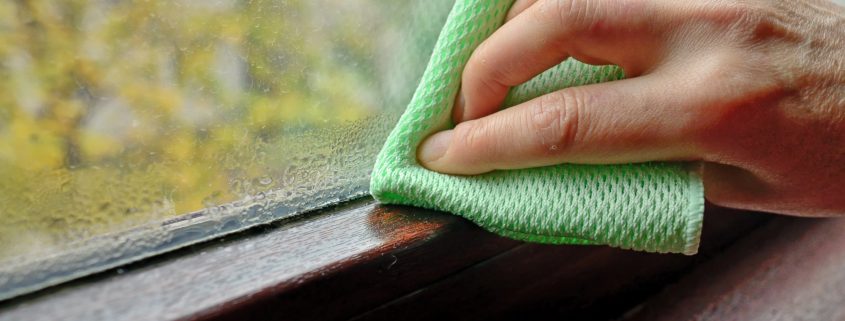
Interior condensation — moisture on the room-facing surface — is the most common type. It indicates high indoor humidity combined with cold window surfaces. Particularly common in bedrooms (we breathe out moisture overnight), kitchens, and bathrooms.

Condensation on the Outside

Here’s something that surprises many homeowners: external condensation is actually a sign of good thermal performance. It happens when the outer glass is so well insulated from your home’s heat that it stays colder than the outside air. If you’ve recently upgraded to low-e glazing and see morning condensation outside, don’t worry — it clears as the sun warms the glass.

Condensation Between the Panes

Moisture trapped between the glass panes means the seal has failed. The inert gas (usually argon) has been replaced by humid air. Failed sealed units need replacing — the good news is that with timber windows, you can usually replace just the glazing unit rather than the whole window.

Four Solutions: From Simple to Significant

Solution 1: Improve Ventilation

The single most effective solution. You need moist air out and drier air in.

Trickle vents are small ventilators built into window frames, providing constant background ventilation without significant heat loss. Building Regulations require them in new windows precisely because they’re so effective. Keep them open — closing them defeats the purpose.

Extract fans in kitchens and bathrooms should run during cooking/bathing and for 15-20 minutes afterwards. Humidistat-controlled fans that activate automatically are particularly useful.

Window opening: Even in winter, five minutes of ‘purge ventilation’ (windows wide open) is more effective than leaving them on a crack all day.

Solution 2: Reduce Humidity at Source

Sometimes you’re producing more moisture than ventilation can handle:

  • Drying clothes indoors: One load releases ~2 litres of water. Use a vented tumble dryer or dry in a closed room with window open.
  • Cooking: Cover pans and always use the extractor.
  • Showers: Keep bathroom door closed; run fan during and after.
  • Unflued gas heaters: Produce huge amounts of water vapour. Avoid if possible.

Solution 3: Use a Dehumidifier

If ventilation alone isn’t enough — particularly in older properties or basements — a dehumidifier can help. Modern refrigerant models extract several litres daily and cost around 3-5p per hour to run.

Aim for 40-60% relative humidity. Below 40% causes dry skin; above 60% encourages condensation and mould. A simple hygrometer (under £10) lets you monitor levels.

Solution 4: Upgrade Your Glazing

If you’ve got single glazing or failed sealed units, upgrading makes sense. Modern double glazing with a decent U-value (1.4 W/m²K or better) keeps the inner glass warmer, making condensation less likely.

Triple glazing and argon-filled units perform even better. But honestly, for most UK homes, good double glazing combined with adequate ventilation solves the problem.

Quick Diagnosis Guide

Where’s the condensation? Here’s what to do:

  • Inside surface → Improve ventilation and reduce humidity sources
  • Outside surface → Nothing to fix — your glazing is working well
  • Between panes → Seal has failed — replace the glazing unit
  • Throughout house → General ventilation problem — consider whole-house approach

Frequently Asked Questions

Why do I get condensation on my new windows?

New windows are more airtight than old ones. Less background ventilation means humidity builds up. It’s not a fault — you just need to adjust habits. Keep trickle vents open and ventilate briefly each day.

Is condensation damaging my timber frames?

Occasional condensation won’t harm properly finished timber. Persistent heavy condensation pooling on sills can eventually penetrate the finish. Wipe away pooled water regularly and maintain frames with microporous paint.

What humidity level should I aim for?

Keep relative humidity between 40-60%. Below 40% causes dry skin and respiratory issues; above 60% encourages condensation and mould. A cheap hygrometer helps you monitor this.

Will secondary glazing help?

Yes — secondary glazing warms the primary window and reduces humidity transfer. A good solution for listed buildings where replacing original windows isn’t permitted.

Getting Condensation Under Control

Window condensation comes down to moisture meeting cold surfaces. Address the moisture, warm up the glass, or improve ventilation — and the problem improves. Start simple: open trickle vents, use extract fans, avoid drying clothes indoors. If that’s not enough, add a dehumidifier or consider upgrading your glazing.

At Timber Windows Direct, all our windows come with integrated trickle vents and high-performance sealed units. Get in touch to discuss replacement windows for your property.

Laminated vs Toughened Glass for Security: The Complete Guide

In this article, you’ll discover:

  • The fundamental difference between laminated and toughened glass
  • Why toughened glass offers zero security benefit
  • How BS EN 356 security ratings work
  • Real cost comparisons for upgrading your glazing

There’s a common misconception: “toughened glass is security glass.” We hear it all the time from homeowners. And it’s completely wrong.

Both glass types are stronger than standard float glass. But they behave completely differently when someone tries to break through. One provides genuine security. The other keeps your family safe from accidents but won’t slow down a burglar.

This guide explains what each type does, how security ratings work, and when you should invest in upgraded glazing for your timber windows.

Toughened Glass: Safety, Not Security

Toughened glass — also called tempered glass — is heat-treated to be 4-5 times stronger than standard glass. The manufacturing process creates surface tension that makes it significantly harder to break.

Here’s the thing: when toughened glass does break, it shatters completely into small, relatively harmless granules. That’s the point — it’s designed as safety glazing, protecting people from dangerous shards. But that same property makes it useless for security — once broken, there’s no barrier left.

Where Toughened Glass Should Be Used

Building Regulations (Approved Document K) require safety glass in ‘critical locations’:

  • Glazing within 800mm of finish floor level
  • Glazing in doors and side panels within 300mm of doors
  • Low-level glazing in bathrooms

Toughened glass is also more resistant to thermal stress — useful where glass experiences temperature differences.

Laminated Glass: The Real Security Option

Laminated glass consists of two or more glass panes bonded with an interlayer — typically PVB (polyvinyl butyral) or EVA resin. This interlayer is the key to everything.

When struck, the outer glass may crack or shatter, but the pieces stay bonded to the interlayer. The glass doesn’t fall away. To get through, an intruder must keep hitting the same spot repeatedly, gradually breaking through layer after layer.

This delay defeats most break-in attempts. Burglars typically want to be in and out within 2-3 minutes. Spending 30-60 seconds hammering at a window that won’t give way — making noise the whole time — isn’t worth the risk.

Additional Benefits

  • Superior sound insulation — the interlayer dampens vibrations
  • UV protection — blocks up to 99% of UV rays
  • Safety compliance — also qualifies as safety glass under Building Regulations

BS EN 356 Security Ratings Explained

BS EN 356 is the European standard for testing glass resistance to manual attack. The standard divides into two categories:

Ball drop tests (P1A to P5A): A steel ball dropped from increasing heights. Measures resistance to opportunistic attack.

Axe tests (P6B to P8B): Glass struck repeatedly with an axe. Measures resistance to sustained attack.

ClassTest MethodTypical Application
P1A3 ball drops from 1.5mBasic residential
P2A3 ball drops from 3mStandard residential upgrade
P4A3 ball drops from 9mHigh-value homes
P6B-P8B30-70+ axe blowsCommercial, high-risk

For most residential applications, P2A or P4A provides excellent security. Higher ‘B’ ratings are designed for banks and commercial premises.

Cost Comparison

Realistic figures for 2026 (per m² of glass):

  • Toughened: +£15-25 over standard float glass
  • Laminated (basic): +£35-45
  • Laminated (P2A): +£45-55
  • Laminated (P4A): +£55-70

For a typical sash window (1.2m²), P2A laminated adds £55-65. For 10-12 windows? Around £500-800 extra. Some insurers offer premium discounts for certified security glazing.

Making the Right Choice

Choose toughened when:

  • Building Regulations require safety glass
  • The window is prone to accidental impact
  • Thermal stress is a concern

Choose laminated when:

  • Security is a genuine concern (ground floor, rear of property)
  • You want improved sound insulation or UV protection
  • Insurance requires or incentivises security glazing

Best of both worlds: Many timber window manufacturers supply double-glazed units with toughened inside and laminated outside — Building Regs compliance plus genuine security.

Frequently Asked Questions

Is laminated glass burglar proof?

No glass is truly burglar-proof, but laminated glass significantly delays break-in attempts. Even basic laminated can withstand several minutes of sustained attack. The delay usually deters opportunistic burglars.

Is toughened glass the same as safety glass?

Toughened is one type of safety glass. Laminated also qualifies under BS 6206 and EN 12600. Both reduce injury risk — toughened by shattering into granules, laminated by holding fragments together.

Which is better for noise reduction?

Laminated provides significantly better acoustic insulation. The PVB interlayer dampens sound vibrations, reducing noise by 3-5 decibels more than standard double glazing.

Do I need security glass on all windows?

Focus on vulnerable points: ground-floor windows, accessible rear windows, glazed doors, and windows hidden from view. Upper floors visible from the street are lower priority.

The Bottom Line

If security is your goal, laminated glass is the only sensible choice. Toughened is excellent for safety but won’t delay a break-in. The upgrade cost isn’t as high as many assume — for ground-floor windows, it’s an investment that makes real sense.

At Timber Windows Direct, we supply windows with any glazing specification. Contact us to discuss the right options for your property.